Sacraments
The Seven Holy Sacraments (Raze Qaddishe)
The Ancient Church of the East holds to seven Holy Sacraments (Raze), which are divine channels of grace established by Christ and handed down through the Apostles. As classified by the great East Syriac scholar Mar Abdisho bar Brikha (14th century), the seven sacraments are:
- Priesthood (Kahnuta): The foundational sacrament through which apostolic succession and divine authority are transmitted to celebrate all other holy mysteries.
- Holy Baptism (Mamoditha): The sacrament of spiritual rebirth, administered by triple immersion in water in the name of the Father, Son, and Holy Spirit.
- Anointing of Holy Oil (Rushma / Mshikhuta): The seal of the Holy Spirit, administered alongside Baptism using consecrated oil (oil of unction).
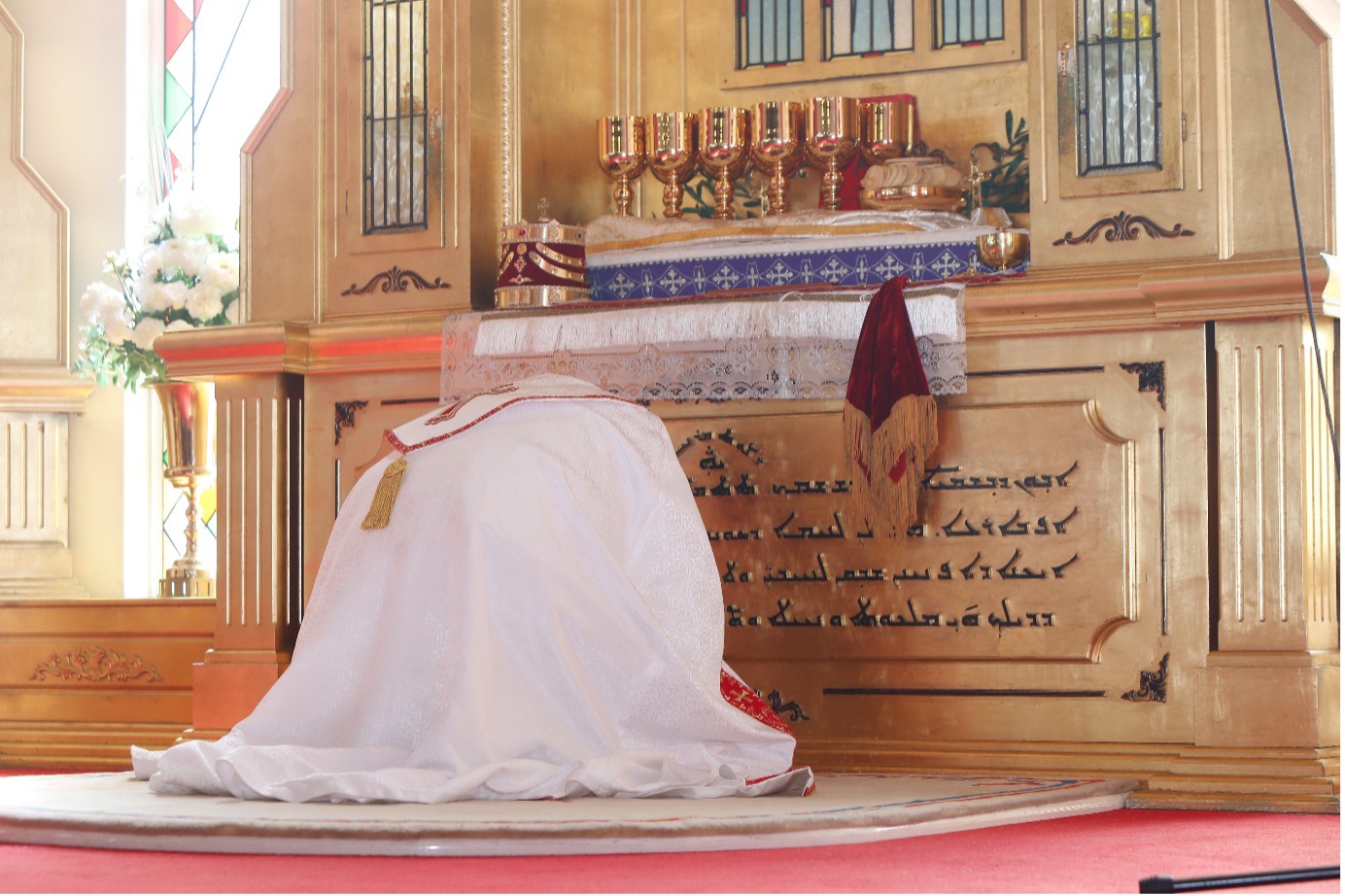
- Holy Eucharist (Qurbana Qaddisha): The central act of worship in which the true Body and Blood of Christ are partaken under the forms of bread and wine.
- Remission of Sins / Absolution (Khussaya): The sacrament of repentance and forgiveness. While general absolution is pronounced to the congregation prior to Holy Communion, personal confession before a priest is made when requested or spiritually necessary.
- The Holy Leaven (Malka): A unique sacrament preserved continuously in the Church of the East. According to sacred tradition, a portion of the original bread from the Last Supper—mixed with water and blood from the side of Christ—was brought to the East by the Apostles. A portion of this sourdough (Malka) is continuously renewed and incorporated into the eucharist bread for every Qurbana.
- The Sign of the Life-Giving Cross (Rushma d-Sliwa): The veneration and ritual signing of the Cross, through which believers receive divine protection, blessing, and the pledge of Christ’s victory over death.
Worship, Liturgy, and Sacred Traditions
The Sign of the Cross
When making the Sign of the Cross, the worshiper joins three fingers together to symbolize the Holy Trinity. Touch the forehead first, saying "In the name of the Father," then the chest, saying "and of the Son," then moving from the right shoulder to the left shoulder, saying "and of the Holy Spirit, Amen."
The Holy Eucharist and Fasting
The Holy Eucharist (Qurbana) is received fasting and distributed in both kinds(the Body and Blood) to all baptized clergy and laity alike.
Sacramental Symbolism and Veneration
In accordance with ancient tradition, carved or painted images and icons are not utilized in liturgical worship. The primary object of reverence is a plain, unadorned Cross, symbolizing Christ’s glorious Resurrection rather than His suffering.
The Holy Scriptures
The Church uses the Peshitta (meaning "Simple" or "True"), the ancient Holy Scriptures in original Aramaic—the very language spoken by our Lord Jesus Christ and His Apostles.
The Sacred Liturgy
The primary Eucharistic Liturgy of the Church is the Anaphora of the Holy Apostles Mar Addai and Mar Mari, one of the oldest continuously used Eucharistic prayers in all of Christendom, originating from the early church of Edessa and Mesopotamia.
The Nine Orders of Priesthood
The hierarchy of the Church mirrors the celestial hierarchy of heaven. The nine orders are divided into three triads:
- High Priesthood: Patriarch, Metropolitan, and Bishop (representing Cherubim, Seraphim, and Thrones).
- Priesthood: Archdeacon, Corbishop, and Priest (representing Dominions, Virtues, and Powers).
- Diaconate: Deacon, Subdeacon, and Reader (representing Principalities, Archangels, and Angels).
Through this sacred structure, the Church on earth stands in eternal union with the Church in Heaven.